

Donors, volunteers, board members, beneficiaries, partners, and sponsors are all important elements in a complex ecosystem, with nonprofit organizations functioning in them. The manual management of these relations in the spreadsheets and sporadic emails usually creates confusion, missed follow-ups and opportunities. This is where stakeholder management software is required. It offers a computerized platform to manage connections, communicate, and make long-term relationships more solid. Software, in the modern digital world, is no longer a luxury; it is a need among nonprofits. The nonprofits should develop trust, transparency, and consistent communication as competition for donations and grants intensifies.
Effective stakeholder management software benefits enable organizations to develop all relationships in a strategic, as opposed to a reactive, way.
Key Stakeholder Management Software Benefits
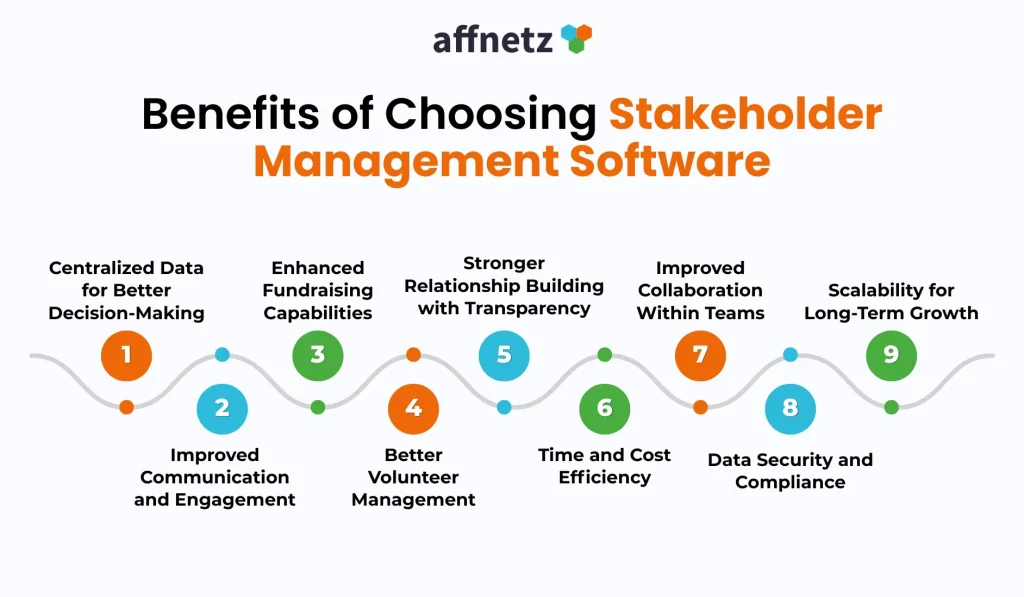
Centralized Data for Better Decision-Making
Centralized data management is one of the largest advantages of stakeholder management software. NPOs tend to lose data between various tools or even between users. Once the contact information, donation history, participation in events and communication records are placed on a single platform, teams have an all-embracing picture of all stakeholders.
This centralized model eradicates duplication and errors are minimized. It also helps leadership teams to make data-driven decisions. Nonprofits no longer need to guess about the most active donors and volunteers but may access real-time information. Contemporary nonprofit software can be equipped with dashboards and reporting features that convert raw data into strategies to be taken.
Improved Communication and Engagement
Communication is the key to the success of any nonprofit. Stakeholder engagement software also enables organizations to divide the contacts by interests, donation or the type of involvement. This enables one to send customized messages as opposed to mass emails that are generic.
As an illustration, a nonprofit can notify significant donors with specific messages and also circulate volunteer opportunities among individuals within the community. Follow-ups are also not overlooked because of automated reminders. Due to that, relationships become more personal and meaningful. Stakeholders are likely to become loyal and become more involved when they feel valued and informed.
Enhanced Fundraising Capabilities
Fundraising is a substantial business for nonprofits, and the stakeholder management software directly helps this objective. Organizations can determine possible significant decline and frequent donors by monitoring the history of donation and patterns of engagement. This understanding assists the teams in creating smarter campaigns to raise funds.
Nonprofits can use built-in campaign tracking and analytics to gauge the effectiveness of fundraising campaigns and areas to improve their effectiveness. Stakeholder engagement software also promotes ease of sending the thank-you messages, tax receipts and progress reports. Such minor yet recurring intangibles go a long way in enhancing retention levels among donors. Professional software in the case of nonprofits results in more reliable and sustainable funding in the long run.
Better Volunteer Management
Many non-professionals are propelled by volunteers in their work. Nevertheless, the scheduling of volunteers, skills and availability may easily take its toll without appropriate systems. The stakeholder management software also assists nonprofits in keeping good records concerning the volunteer hours, interests, and previous involvement.
Such systematic behavior simplifies the process of delegating work and rewarding efforts in an appropriate way. When the volunteers are made to feel organized and valued, they will give even more commitment. The stakeholder engagement software is also useful for sending reminders of the upcoming events and training sessions in order to decrease the cases of no-shows and miscommunication.
Stronger Relationship Building with Transparency
Everything in the nonprofit world depends on trust. Partners and donors would like to be aware of how their funds are being spent. Stakeholder management software improves the level of transparency since there is a clear record of financial contributions, project updates and a history of communication.
Nonprofits can simply share updates on progress and impact reports through automated reporting and systematic documentation. Such disclosure creates credibility and enhances long-term relationships. Accountability and professionalism would increase the confidence level of stakeholders in the organization. Nonprofit software leads to transparency being a normal practice and not a stressful activity.
Time and Cost Efficiency
There are numerous nonprofit teams that have a tight budget and few employees. Manual data entry or email searching is directly related to productivity. Stakeholder management software handles repetitive duties; that is, the follow-up/reminders, updates of data, and creation of reports are automated.
The load on administration is lessened and the staff is able to dedicate time to the strategic planning, outreach and mission-oriented work. Although it might appear as an additional cost to invest in stakeholder engagement software, in the long run, it will save a lot of time, raise more funds, and make stakeholders stay with the company, which is much more than the expenditure. Software efficiency among nonprofits eventually leads to the overall growth of the organization.
Improved Collaboration Within Teams
The common departments in which the nonprofit teams operate include fundraising, communications, outreach, and operations. In the absence of a common system, teamwork is disjointed. Software managing the stakeholders will provide a central workspace where all team members can get the latest information.
This visibility will avoid duplication of efforts and maintain the uniformity of communication with the stakeholders. As an illustration, a donor must not get different messages when they are approached by the various team members. The stakeholder engagement software maintains smoothness among all, ensuring that the outside supporters have a professional and unified experience.
Data Security and Compliance
There is a responsibility when dealing with donor and stakeholder information. The current software used by nonprofits has a robust security system in data encryption, access control, and safe cloud storage. These properties guard sensitive data as well as minimize the chances of information theft.
Also, numerous stakeholder management software have the capability of facilitating regulatory compliance needs. This minimizes legal risks and increases stakeholder trust. Nonprofits cannot afford to compromise secure systems in a period where the issue of data privacy is on the rise.
Scalability for Long-Term Growth
With the increase in the number of nonprofit stakeholders, the stakeholder networks grow at a high rate. What can achieve great success in a small team of 500 contacts might not succeed in handling 10,000 supporters. The stakeholder management software is scalable to enable the organization to grow without losing its efficiency.
Stakeholder engagement software conforms to the increasing requirements, whether launching new fundraising campaigns, opening branches in new regions, or enhancing volunteer programs. Nonprofits do not have to keep changing tools but rather use a single integrated system that will keep up with them.
Conclusion
These days, the nonprofits are forced to work in a competitive and digital-first world, which means that they have to work in a strategic manner to be as impactful as possible. The stakeholder management software for nonprofits offers the framework, productivity, and understanding to ensure the proper management of relations. The advantages are major in the form of centralization of data and better communication as well as better fundraising and volunteer coordination.
Stakeholder engagement systems enable organizations to establish better and more open connections with donors, volunteers, and partners. Investing in nonprofit-friendly software would not only ensure the efficient work of the organizations but also provide them with the basis for long-term success and sustainable growth.
What is stakeholder management software?
Stakeholder management software is an online application that assists organizations to monitor, maintain and involve stakeholders including donors, volunteers, partnerships and beneficiaries, thus ensuring coordinated communications, data documentation, and relationship development in an organization.
Why do nonprofits need stakeholder management software?
Stakeholder management software helps nonprofits to manage donor and volunteer information effectively, enhance communication, build relationships, track engagement, and simplify operations, which will eventually enhance transparency, trust, and long-term support of their mission.
What are the top stakeholder management software benefits for nonprofits?
The main advantages are that data is centralized, stakeholder communication improves, better engagement tracking is achieved, reporting is enhanced, retention of donors is improved, workflows are simplified, and better collaboration between teams is established, which leads to an increase in the overall efficiency and effectiveness of the nonprofit itself.
What’s the difference between stakeholder management software and a CRM?
Unlike the nonprofit-oriented stakeholder systems, stakeholder management software is oriented towards managing relationships with all stakeholders, such as donors and volunteers, whereas CRM is oriented towards customer relationships, sales tracking, and marketing, so it is business-oriented as opposed to nonprofit-oriented.
