
For small nonprofits, establishing a strong and sustainable relationship with donors is crucial to achieving a successful mission. Although the recruitment of donors is important in increasing the support levels, studies have always indicated that it is more economical and effective to retain existing donors than to keep acquiring new ones. As a matter of fact, a few percentage points of donor retention can greatly enhance lifetime donor value and fundraising efficiency.
Here, the modern nonprofit donor management software enters the picture. Organizations can maximize donor retention approaches, decrease churn, and develop long-term loyalty with features like CRM donor management software, automated engagement tracking, and reporting dashboards.
Understanding Nonprofit CRM
A nonprofit CRM (Constituent Relationship Management) system is not a donor database; it is the center of managing donor, volunteer, event participant, committee members, supporter, and various other relationships. In contrast to spreadsheets or siloed systems, CRM platforms offer 360 perspectives on donor history, communication, giving patterns, and points of engagement.
Implementing donor management software that uses nonprofit-specific features, a nonprofit organization can monitor the flow of donations, streamline outreach, quantify impact, and enhance one-to-one communication. Advanced CRM solutions were also paired with donor recruiting software, online fundraising tools, and event management in 2025 and are thus important tools to grow nonprofits.
Difference Between Recruiting Donors and Retaining Donors
Although the recruitment and retention of donors are equally important, they demand very divergent approaches.
- Donor Recruitment is concerned with acquiring new adherents by campaigning, organizing, or online efforts. Technology such as donor recruitment software assists the nonprofit with identifying its prospective supporters and integrating them into the donor equation.
- Donor Retention focuses on retaining current donors and motivating them to become interested, engaged, and ready to donate again. Research indicates that it is much cheaper to retain an old donor than find a new donor and that loyal donors tend to give a lot in the long run.
The compromise lies in the fact that one is also investing in the recruiting process, but they focus more on retention by using nonprofit donor management software that allows for customizing communication, sending automatic reminders, and fostering relationships.
Donor Retention Strategies for Small Nonprofits
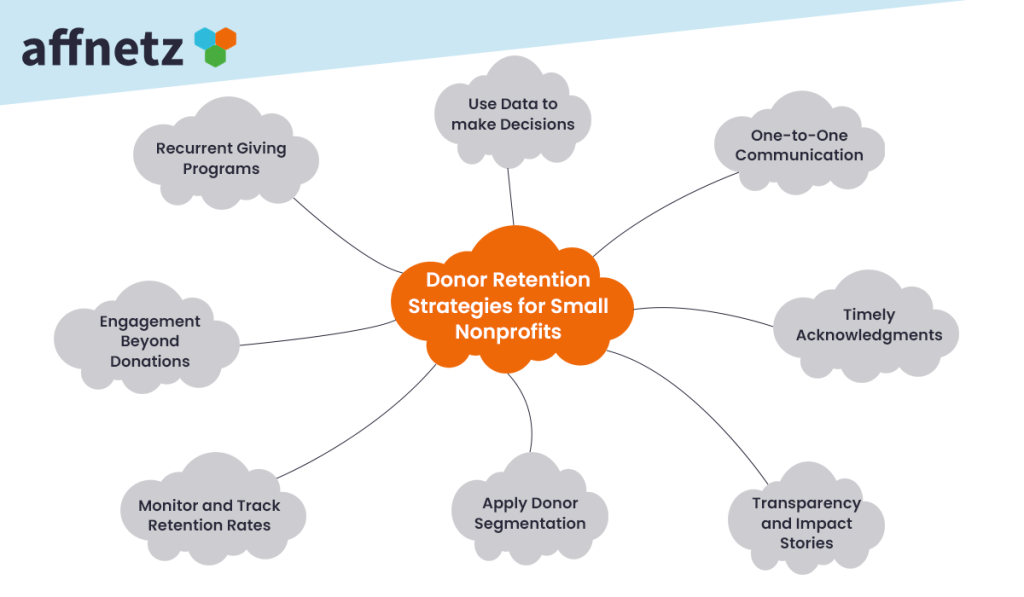
Small nonprofits with limited budgets and staff require smart, cost-efficient solutions. The following are strategies that have proven to enhance retention:
- One-to-One Communication: Automate with CRM donor management software to segment donors by donation history and personalize thank-you notes, updates, and appeals.
- Timely Acknowledgments: Donors who are thanked promptly will build more trust and enhance relationships. This can be automated using donor retention software to provide consistency.
- Transparency and Impact Stories: Get an account of how the donations are applied. Donors would desire to know how their money is put to the test.
- Recurrent Giving Programs: Promote giving on a monthly or quarterly basis to have a continuous flow. CRM software can establish automated reminders and convenient payment.
- Engagement Beyond Donations: Engage donors in events, volunteering, or surveying them to further connect with the mission.
- Monitor and Track Retention Rates: Learn to calculate the donor retention rate (defined below) to understand your strengths and weaknesses in your donor engagement strategy.
- Apply Donor Segmentation: Not all donors should be approached in the same way. There are donors, first-time givers, and recurring donors, and each has to engage in a different manner.
- Use Data to make Decisions: Nonprofits can use donor management software to analyze donor behavior to support fundraising and boost retention efforts.
Strategic Donor Segmentation: Major Donors vs. Regular Donors
Not every donor is a similar donor, and nonprofits need to realize that major donors need a different strategy than regular donors.
Major Donors: Major Donors give large amounts and typically transform a nonprofit. It is important to develop personal, high-touch relationships with the large donors: regular communication on a one-on-one basis, providing unique updates, and showing direct impact. CRM systems have the capacity to identify high-capacity donors, monitor the engagement touchpoints, and develop individual steward plans.
Regular Donors: These are the ones who provide small, still consistent donations. They are the foundation of a nonprofit. Automated recurring giving programs, customized thank-you messages, and opportunities to engage with the community are some of the strategies that ensure that they remain engaged and loyal in the long term.
Using CRM to Keep Track of Donor Engagement and Support
Current CRM donor management software is set to make donor contact easier and automated. Nonprofits can:
- The history track to learn the trends in giving.
- Check the donor retention metrics and determine the performance of the campaigns.
- Automate follow-ups such as the thank-you email, updates on impact, and the recurring donation reminders.
- Integrate with donor recruitment software for a seamless transition from first-time giver to long-term supporter.
- Focus on LYBUNT and SYBUNT reports for lapsed donors, and have a plan in place to approach them with updates.
Also, most systems have dashboards that automatically compute metrics, such as donor churn, average gift size, and total fundraising growth.
How to Calculate Donor Retention Rate
Donor retention rate is one of the most significant indicators of any nonprofit. The formula is:
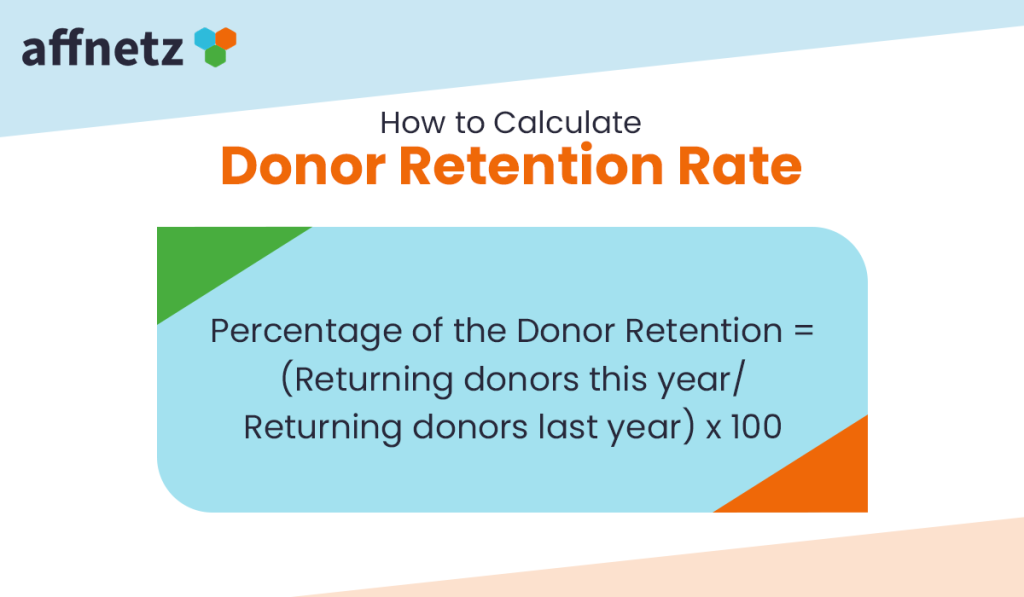
Suppose that your nonprofit got 200 donors last year and 120 of them were able to donate this year, your donor retention would be:
(120 / 200) x 100 = 60%
Monitoring this regularly in your donor retention software helps gauge progress and identify areas for improvement.
Common Mistakes and How to Avoid Them
Even the most well-intended nonprofits can fall into some of the traps that undermine retention. The following are some of the common pitfalls:
Excessive emphasis on acquisition: Continuous targeting to acquire new donors without paying much attention to current donors.
Generic communication: The same message can be conveyed to all the donors, and the contact with the donor is less personal.
Ineffective data control: Without an effective nonprofit donor management software, donor data is never reliable and up-to-date.
Delayed admissions: The donors are not appreciated on time, and this lowers satisfaction.
Failure to seek feedback: This may negatively affect relationship building because feedback is not sought from the donors.
A mixture of strategy, regular communication, and reliable CRM donor management software can help to avoid these pitfalls.
Conclusion
The key is donor retention to develop long-term growth and mission sustainability of a small nonprofit. The need to recruit new supporters remains a need, but retention is more rewarding in terms of input and expenditure.
Donor management software, donor retention software, and CRM donor management software can help nonprofits simplify their engagement, customize communication, and measure outcomes. The capacity to calculate the rate of retention of donors will ensure that data-driven decisions are made to prevent common errors and maintain the invaluable relationships with the donors.
Ultimately, the nonprofits would win in 2025 with smart technology and real, mission-based relationship building. Even small nonprofits can alter the future and make a splash when concentrating on the retention process along with the recruitment.
