

In the case of nonprofits, donors serve as the lifeline, enabling them to execute their mission. No individual contribution, however large or small, is insignificant in the creation of a difference. However, monitoring the donor activities, preferences, and engagement may be overwhelming, especially when one does it manually. Not only time-consuming, but they are also subject to error, spreadsheets, notes, and long chain emails. Donor Management Software fits in there.
Nonprofits can free up time, reduce errors, and focus on developing more effective and long-term relationships with their supporters by automating donor engagement tracking. We will discuss in this blog what it actually means, the difficulty of manual tracking, and how the process can be automated using the correct tools and strategies.
Exploring Donor Engagement
It is essential to understand what donor engagement entails before discussing automation. In simple terms, it can be said to be the level of affiliation and engagement a donor makes to the mission of a nonprofit. Engagement does not only involve a donation but rather the continuous engagement, interest, and loyalty.
Donor engagement may be in the form of:
- Taking part in charity concerts.
- Replying to the newsletters or campaigns.
- Bringing your cause to social media.
- Giving up time as well as money.
- Giving feedback or being surveyed.
As soon as a nonprofit can quantify and comprehend such behaviors, the process of turning donors into long-term sponsors becomes simpler. And there is the point where software for donor management is invaluable, as it allows concentrating data and gaining the insight to enable organizations to make significant decisions.
Challenges of Manual Tracking
A good number of nonprofits, particularly small or mid-size organizations, begin with spreadsheets, email databases, and paper binders to manage donors. Whereas this can function in the early stages, as the number of donors increases, the manual method poses several problems:
Time-Consuming Processes
Employees waste time and time again in updating sheets, writing follow-ups, and manually entering donor information. This saves time to do other, more meaningful work.
High Risk of Errors
Manual input can contain errors, such as a record being entered twice, a contribution being omitted, or wrong donor information.
Absence of Centralized Information
Data can be fragmented across various platforms, and it can be difficult to have a 360-degree perspective of the journey of a donor.
Difficulty in Personalization
It is difficult to send personalized emails or targeted appeals without effective tracking.
Missed Opportunities
A lack of following up with a donor/ lack of acknowledging a faithful supporter may cause donor fatigue or disengagement.
The use of manual tracking cannot be sustained in a digital-first setting. That is why donor management software for nonprofits is a game-changer.
Steps to Automate Donor Tracking
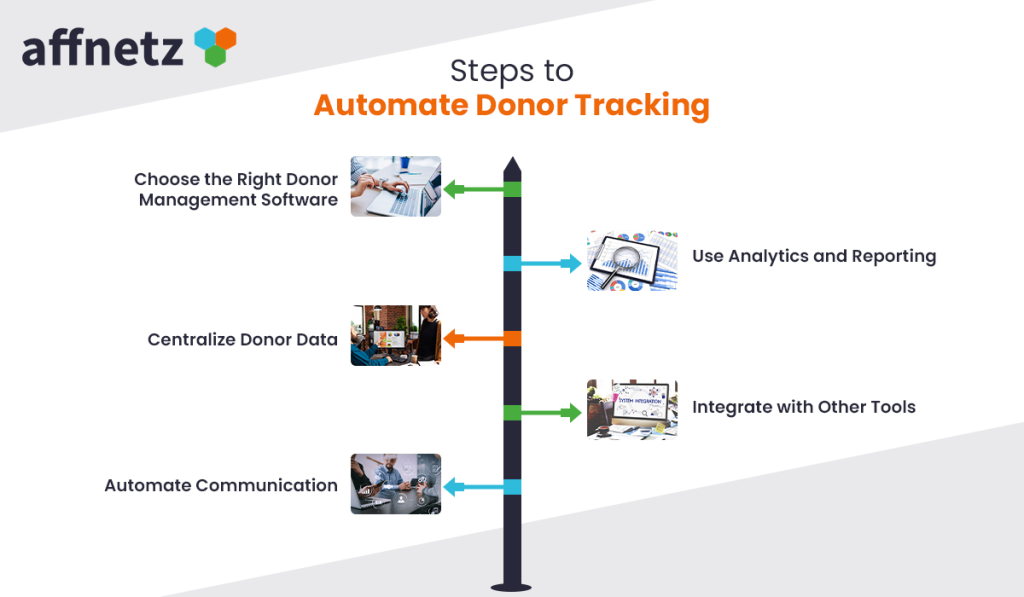
Donor engagement can and should be automated, but that does not imply the personal touch is lost; it only makes it easier and more effective with the help of technology. These are some steps to assist nonprofits in moving to automation, as opposed to manual tracking:
1. Choose the Right Donor Management Software
Find nonprofit donor management software that is the right size, purpose, and budget. The right tool should:
- Concentrate on donor details.
- Provide real-time donor and engagement monitoring.
- Permit donor segmentation on the basis of behaviour or contribution.
- Combine with email and social media.
2. Centralize Donor Data
After acquiring the software, you can import all your donor data into a single system. A centralized database is a guarantee that all the members of the team can view the same information, and cooperation becomes smooth.
3. Automate Communication
Install automated expressions of gratitude, recurrence of donation reminders, and invitations to events. These guarantee the donors a feeling of recognition and identification without having to go through handwork every time.
4. Use Analytics and Reporting
Nonprofit Donor Management Software typically includes reporting software. Identify some of these patterns to determine who is the most active donor, who is not active, and which campaign is the most successful.
5. Integrate with Other Tools
Integrate your donor management system with social media, event organizers, and accounting to have a clear picture of donor engagement. This makes sure that no interaction is neglected.
Strategies to Enhance Donor Engagement
Automation is powerful, yet the strategies behind it are equally important. The following are a few best practices on how nonprofits can be more engaging when utilizing technology:
Personalized Communication
With your nonprofit donor management software, use data to send messages that resonate with donors. E.g., the acknowledgment of a donor that he/she supports a particular program of interest to him/her makes him/her feel valued.
Segment Donors
Not all donors are the same. You can divide them into specific campaigns based on the frequency, amount, or type of involvement in the donation.
Create Donor Journeys
Arrange automated travels to plans. To illustrate, a new donor may get a welcome email, after which they get a story of impact, and then a request to attend an event.
Show Impact Clearly
Donors would like to see the difference in the contributions they make. You can update your shares, post photos, or testimonials directly by using the communication tools of your software.
Encourage Recurring Donations
Automated systems may remind the donor to give monthly or provide easy sign-ups to give recurring contributions.
Celebrate Milestones
Monitor the anniversaries, birthdays, or contribution milestones of your donors and send a personalized message of appreciation through your system.
Conclusion
It is a long-term relationship-oriented engagement of donors, rather than a solicitation of funds. However, it is difficult to realize this objective successfully with the help of manual tracking methods used by nonprofits. Through the adoption of donor management software, organizations will be able to streamline their operations, minimize mistakes, and concentrate on the actual reason why they exist: to make valuable relationships with their supporters.
Automation does not replace the human factor, but rather gives nonprofits the capability to provide them more effectively and consistently. The right tools and strategies will allow nonprofits to assure each donor that he or she has not been neglected and that every supporter will feel appreciated.
In the modern world of fast-paced business, investing in donor software for nonprofits is more than merely a time-saving solution; it is a long-term survival.
FAQs—Frequently Asked Questions
Q.1 How can automation enhance donor engagement?
Automation will enable nonprofits to identify and send thank-you notes, reminders, and impact updates by sending them in bulk, but automatically. It makes donors feel that they are appreciated without straining the resources of the staff. Automated workflows can divide supporters based on their giving history, engagement, or preferences, and reach out to them in a manner that is relevant to them. This uniformity enhances the bonding of relationships, fosters loyalty in the long run, and raises the chances of a second donation, as it keeps the supporters abreast of the cause and emotionally attached to it.
Q.2 Is automation suitable for small nonprofits?
Yes, automation is very appropriate in small nonprofit organizations since it will lessen the amount of manual work and will make such organizations look professional. With a small number of people, it is feasible to automate emails, reminders, and acknowledgments, and guarantee active interaction without additional effort. Several lower-priced donor management software packages provide the ability to be automated, which enables small nonprofits to save time, reduce human error, and devote more hours to accomplishing their mission at the same time as offering personalized and meaningful donor experiences that encourage more trust and support.
Q.3 How can donor engagement tracking improve fundraising campaigns?
The engagement tracking of the donors will give an idea of who is active, when they make their donations, and why. Knowing these patterns, nonprofits are able to make more specific campaigns and appeals. Organizations can avoid sending generic messages and customize fundraising requests that can be appealing to the interests and time of the donor. It enhances the response rates, donor satisfaction, and, ultimately, the fundraising success since supporters feel valued and motivated because of personalized contact, corresponding to their values.
Q.4 How does manual tracking increase errors in donor data?
The manual tracking is usually based on spreadsheets or paperwork, and with the spreadsheets or papers, there is always a possibility of human error, such as duplication, misspelling of names, or old contact details. Donor lists become uncontrollable and thus incomplete or inaccurate with the increase in donor lists. Such mistakes may also make nonprofits deliver the wrong messages, fail to engage with others, or even insult the donors. In the long run, inaccurate data undermines confidence and the success of fundraising.
Q.5 How do CRMs help in tracking donor interactions?
CRMs (Customer Relationship Management systems) are systems that consolidate the information about donors, and all the interactions, donations, and communications are centralized. They assist nonprofits in monitoring the history of giving, areas of interest, and participation in events effectively. Using this information, organizations will be able to personalize outreach and schedule follow-ups, and identify loyal or at-risk donors. CRM systems also create valuable reports, and, therefore, measuring the effectiveness of campaigns and perfecting the strategies becomes more convenient. This structured strategy reinforces the relationship with donors and raises as much money as possible.
Q.6 Can AI help analyze donor engagement patterns?
Yes, AI is able to make the donor engagement analysis substantially better. Through the analysis of large volumes of data, AI can determine trends and predict the behavior of donors, including those who will become repeat and/or more generous donors. It can divide donors into better interests, timing, and frequency of giving. Personalized communication strategies are also suggested by AI tools so that the nonprofits can contact the donors with the appropriate message at the appropriate moment, and this increases their loyalty and the success of the campaign.
